


Posture and the Desk Job

As school schedules kick back in and the corporate world starts turning its gears faster again, most of us are settling into a lot more sitting. Kids are staring at smart boards for hours, adults are staring at screens through back-to-back meetings and projects, and the general pace of fall means routines get set for months at a time. This felt like the right moment to revisit an old but genuinely important topic: what all that sitting actually does to your body, and what to do about it before it turns into a nagging ache you can't quite place.
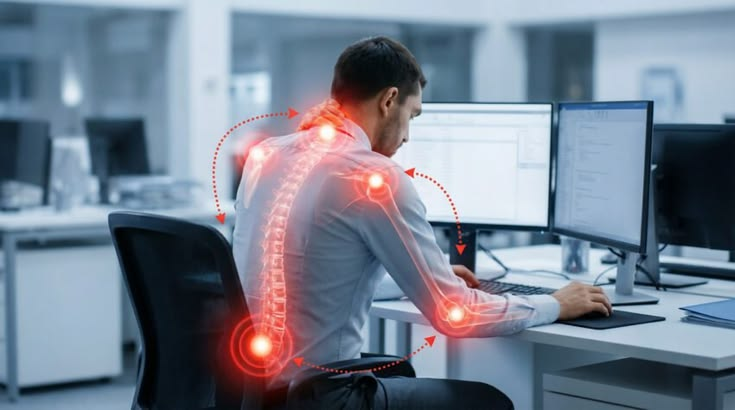
Why Sitting Isn't as Neutral as it Feels
It's easy to think of sitting as a "resting" position, something your body just tolerates without consequence. But the research tells a different story. The average adult in a desk job spends the majority of their waking hours seated, and the body responds to that position the same way it responds to any repeated posture: it adapts to it, whether that adaptation is helpful or not. A few specific things tend to happen the longer you stay seated.
Your hip flexors shorten up. When you sit, your hip is bent to roughly 90 degrees, which puts the hip flexor muscles, the group at the front of your hip that lifts your leg, in a slackened, shortened position for hours at a stretch. Research has found that prolonged sitting is associated with reduced hip extension, a measurable sign that those muscles are adapting to stay short. Over time, tight hip flexors can pull the pelvis forward into an anterior tilt, which changes the alignment of your lower back and increases the mechanical load it carries. One study of low back pain patients even found a direct relationship between hip flexor tightness and reduced lumbar spine mobility.
Your thoracic spine rounds forward. The mid-back tends to curve into a more hunched position during long stretches of sitting, especially while typing. Studies tracking posture during computer work have found that prolonged sitting with a forward-leaning head and increased upper-back rounding raises the mechanical demand on the spine and surrounding muscles, which is part of why sedentary workers report more spinal discomfort the longer the workday goes on.
Your neck compensates. Once the thoracic spine rounds, the neck has to work harder to keep your eyes level and your head up, which usually means it juts forward. Research on seated posture has shown that a more reclined or slouched position increases neck and upper trapezius muscle activity, essentially making those muscles do overtime just to hold your head up. Researchers have also found a meaningful link between increased upper-back rounding and reduced neck mobility, meaning the two areas genuinely feed off each other. A rounded upper back doesn't just look tired, it makes your neck work harder too.
Your circulation and core slow down. Long static sitting also reduces blood flow to the muscles that are being compressed, which is part of why your legs can feel stiff or heavy after a long stretch at a desk. And because sitting takes so much of the stabilizing work away from your core and glutes, those muscles can quietly weaken from disuse over time, which then makes your spine rely even more on passive structures like ligaments and discs to hold you upright.
None of this happens because you're doing something wrong. It happens because your body adapts to whatever position it spends the most time in, and for a lot of us right now, between commuting, desks, and evening screen time, that position is seated for the vast majority of the day.
What Actually Helps
The good news is that the research points to something refreshingly simple: movement breaks matter more than achieving the "perfect" posture. Nobody sits perfectly for eight hours, and that's fine. What matters is not staying in any one position for too long.
Get up every 30 to 45 minutes, even just to stand, walk to get water, or stretch for a minute. Interrupting the position matters more than nailing a flawless seated posture the whole time. One study on prolonged sitting even found that using a simple wearable posture sensor to prompt movement measurably reduced neck flexion and upper-back rounding compared to sitting undisturbed.
Open up the hip flexors with a simple standing or kneeling hip flexor stretch a couple times a day, especially if you notice your lower back tightening by afternoon.
Support your low back curve. A small lumbar pillow or rolled towel behind your low back can help keep your pelvis in a more neutral position instead of collapsing backward into a slump.
Bring the screen up, not your neck down. Whether it's a monitor, a laptop stand, or a smart board angle for kids at school, keeping the top of the screen roughly at eye level reduces the forward head lean that overworks your neck and upper trapezius.
Roll your shoulders and open your chest periodically. A few slow shoulder rolls and a gentle chest stretch can counteract hours of rounding forward and help reset your upper back.
Check your seat height and armrests. Feet flat on the floor, knees roughly level with hips, and elbows supported close to your body all reduce the small compensations that add up across a long day.
For kids, this matters too. Sitting through a school day at a desk built for an average-sized child, staring up at a smart board, involves a lot of the same static postures adults deal with at work. Encouraging kids to stand, stretch, or move during breaks is just as valuable as it is for the adults in the house.
Where We Come In
This is exactly the kind of pattern we look for on the table. If you're coming in with a nagging ache between your shoulder blades, tightness in the front of your hips, or a neck that feels perpetually stiff by the end of the week, your daily sitting setup is worth a conversation. We can help release the tension that's built up, but pairing that with small changes to how you sit day to day is what actually keeps those aches from creeping back in rather than just showing up again next week.
As the season settles into its sitting-heavy rhythm, a few small habits now, at your desk, in the car, or at your kitchen table, can save you a lot of stiffness later.

References
Barbe, T., et al. Prolonged sitting and physical inactivity are associated with limited hip extension: A cross-sectional study. Musculoskeletal Science and Practice, 2020.
Journal of Health Science of Thailand. Hip Flexor Tightness Related with Limited Lumbar Mobility in Low Back Pain Patients, 2023.
PMC. The Influence of Hip Position on Neck Kinematics and Muscle Activity in Healthy and Non-Specific Neck Pain Subjects, 2024.
PMC. Sitting Posture during Prolonged Computer Typing with and without a Wearable Biofeedback Sensor, 2021.
Lau, K.T., et al. Relationships between sagittal postures of thoracic and cervical spine, presence of neck pain, neck pain severity and disability. Manual Therapy, 2010.


Comments