


20-20-20 Rule
- Emily Brown
- Nov 12, 2025
- 3 min read

Give your eyes (& Mind) a Break
Staring at Screens All Day Takes a Toll
We spend more time than ever staring at screens. Between phones, computers, TVs, and tablets, the average American adult logs over seven hours of screen time per day. And that number’s even higher for people who work at desks or use multiple devices.
It’s no surprise that many of us end the day with tired eyes, headaches, and a general sense of fatigue that goes beyond just mental burnout. What you might not realize is that your eyes are working overtime too.
Why Your Eyes Need a Break
When you stare at a screen for long periods, your eyes have to focus on one distance continuously. Over time, that strain causes what doctors call digital eye strain or computer vision syndrome — a collection of symptoms like:

Dry or irritated eyes
Blurred vision
Headaches
Neck and shoulder tension
Trouble focusing when looking away from the screen
Studies show that up to 90% of people who spend more than two hours a day at a computer experience some level of digital eye strain. The main culprit? Lack of rest for the muscles that control your eyes’ focus.
That’s where the 20-20-20 rule comes in.
The 20-20-20 Rule Explained
It’s beautifully simple:
Every 20 minutes, look at something 20 feet away for at least 20 seconds.
This tiny habit gives your eyes a much-needed micro-break, allowing the focusing muscles to relax, your blinking rate to normalize (which prevents dryness), and your mind to reset.
Think of it as a stretch break for your vision. Just like standing up to move your body helps prevent stiffness, pausing to shift your gaze helps prevent eye strain and fatigue.
How to Make It Work in Real Life
Sure, it’s easy to say you’ll look away every 20 minutes, but how do you actually remember? Here are a few easy ways to make it stick:
Set a gentle reminder: Use a phone timer, a smartwatch alert, or a free browser extension like “Stretchly” or “Eye Care 20 20 20.”
Use natural pauses: Every time you send an email, end a Zoom call, or finish a paragraph, that’s your cue to look up and focus on something across the room.
Blink intentionally: Staring at screens makes us blink 60% less often, which causes dryness. Each time you follow the 20-20-20 rule, take a few slow blinks to refresh your eyes.
Look out a window if possible: Focusing on something outdoors like the trees, clouds, or the horizon gives your eyes depth and variation that screens can’t.
Pair it with a posture reset: Roll your shoulders, unclench your jaw, or stand up to stretch. This turns a 20-second pause into a full-body mini recharge.
Why It Matters for Your Whole Body
Eye strain isn’t just about your eyes, it affects your whole system. When your visual system is overworked, your nervous system stays in a low-level stress state, which can increase fatigue and tension. Taking regular breaks lowers that stress response, improving focus and productivity long term.
And while we can’t eliminate screens altogether, we can build small habits that make modern life more sustainable for our bodies.
Pair the 20-20-20 rule with other self-care strategies like regular massage to relieve upper back and neck tension, and time away from screens before bed and you’ll notice a real difference in how your body and mind feel by the end of the day.
Try This Challenge
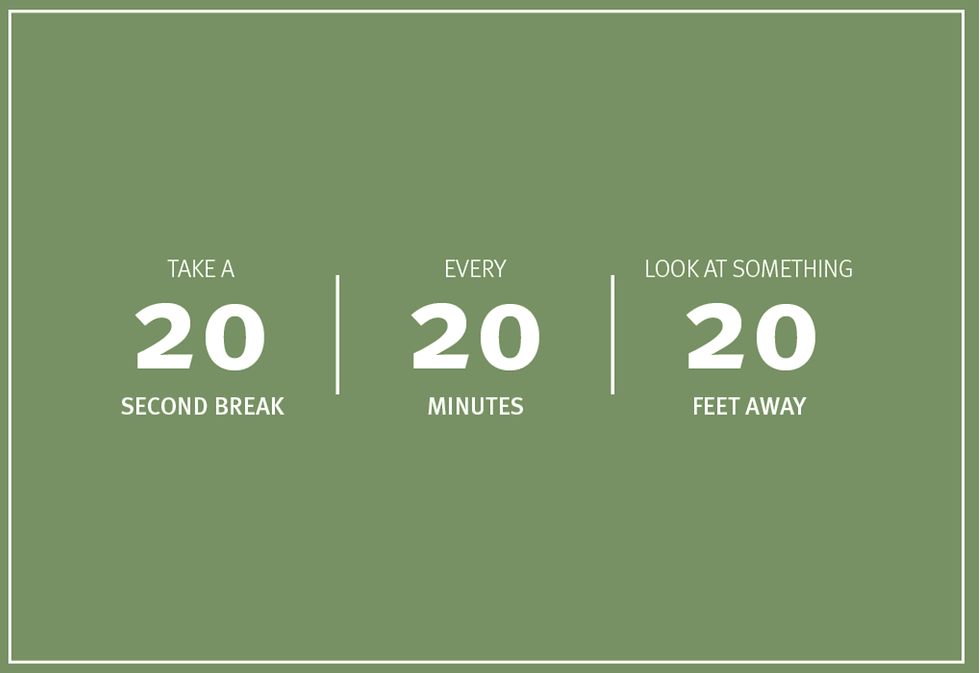
For the next week, commit to trying the 20-20-20 rule during your workday. Notice how your eyes, head, and shoulders feel by the end of the day.
You might be surprised how something that takes less than a minute every half hour can make such a big difference.
Your eyes work hard for you. They deserve a little care, too. And when you need a little something extra to recharge, don’t hesitate to schedule a massage for yourself!
References:
American Optometric Association. “Computer Vision Syndrome.” (2023).
Sheppard, A.L., & Wolffsohn, J.S. (2018). Digital eye strain: prevalence, measurement and amelioration. BMJ Open Ophthalmology, 3(1).
Mayo Clinic Staff. “Eye strain: Self-care.” Mayo Clinic.


Comments